Methodology
According to the AMF, the French financial market authority, in France there are 5 agencies which accord stars to European funds. Because of the use of differing methodologies, the results of the ratings for the same funds by these 5 agencies can be different and is testimony to the varying ways funds are evaluated.
If we do not possess the mathematical basis necessary for the understanding of the calculations themselves, it is of utmost importance to understand the principals of the methodologies utilized.
The presentation of methodology which you are about to read cannot of course detail the totality of the techniques put to use but it gives a summary in a few pages of the principal methodological steps that we follow in order to come to the attribution of ratings:
First principle:
Note, it is necessary first of all to establish coherent sub groups in the fund population.
To establish these sub groups we have guarded an approach by risk,
meaning that we consider that a fund can be compared to another fund if
they have both share a profiles which is similar. For example, if we
take 8 funds ‘ international equities’ some invested mostly in Asia/Pacific, the
others in ‘international equities’. (Note by the way, that this classification
by risk, allows a better appreciation of what you really invest). This principal is clearly of primordial importance because at the time of comparing performances in order to establish a rating, the comparisons will be made, not among the 8 funds themselves but only between funds of a similar risk profile. The Asian funds will therefore be compared between themselves, while the international funds will equally, be compared between themselves.
Brief example illustration :
If we group all the ‘non–French' funds in a single category: ‘International Actions ‘.
| Fund1 | F2 | F3 | F4 | F5 | F6 | F7 | F8 | PERFORMANCE of the category international actions |
Performance 1 year | 08% | 15% | 05% | 10% | 06% | 13% | 11% | 09% | 9.62% |
On the basis of performance compared to the average: | |||||||||
Rank | 6 | 1st | 8 | 4 | 7 | 2 | 3 | 5 |
|
In this example the average of performance of the ‘international equities’ is 9.62% and it is the fund F2 which is top of the classification.
Let’s look now at what happens if we come to identify that F2, F4, F6, and F7 are in fact heavily invested in Asia, and that in fact only F1, F3, F5 and F8 are really profiles which have an international distribution :
The first consequence is of course that only these 4 funds should compete in the category ‘international actions’, thus the table of classification becomes the following:
| Fund 1 | F2 | F3 | F4 | F5 | F6 | F7 | F8 | PERFORMANCE of the category international actions |
Performance 1 year: | 08% | 15% | 05% | 10% | 06% | 13% | 11% | 09% | 7 % |
On the basis of performance compared to the average: | |||||||||
Rank | 2 |
| 4 |
| 3 |
|
| 1st |
|
You will notice that of course, the order of classification has changed; but you will notice equally that the performance of the category is appreciably diminished, which reflects the fact that the Asian funds, which were the best performing, are now ranked amongst themselves.
We have touched here on a fundamental point of systems of rating: CATEGORISATION. This step is fundamental because it determines the universe of reference of the rival funds. A very typical error in this domain consists of mixing, in the same category, smallcap with largecap, resulting in falsification of results.
Second Principle:
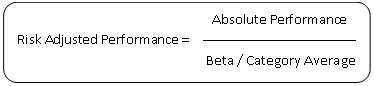
The rating must be established in relation to the performance of competing funds belonging to the same category. The only criterion which reflects the choice that offers itself really to the investor at the moment of selection of one fund or another.
The criteria of gross performance, corrected or even of relative performance to an index are intellectually satisfying but remain a little incorrect.
Third principle:
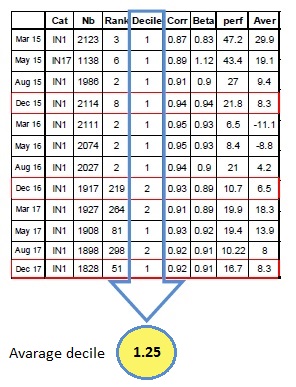
The rating must reflect performance in the medium term. Nevertheless calculating performance date to date over 3 years introduces a significant bias. If one fund has made an exceptional performance or an exceptional under-performance over 2 quarters, it is going to be favored (penalized) during the entire period !
To avoid this bias, we favor a calculation by a series of observations reflecting the frequency of gains, meaning the regular performance of the fund manager. Our methodology is based on 12 annual observations covering nearly 4 years of performance.
Small example illustration : (12 quarterly observations for example)
PERFORMANCE quarterly ( in % ) (Outside selection ) | Q1 | 02 | 03 | 04 | 05 | 06 | 07 | 08 | 09 | 10 | 11 | 12 | TOTAL |
Fund 1 | +1 | +2 | +6 | +8 | +1 | +1 | +1 | +1 | -1 | -3 | -2 | +1 | +16% |
Fund 2 | +1 | +3 | +2 | +2 | +2 | +2 | +2 | +1 | -1 | -1 | -1 | +2 | +14% |
Calculation of performance for exactly 3 years :
+16% for fund 1 which is better ranked than fund 2 (+14%) This performance and this ranking are only just, on condition of having possessed fund 1 for the entire period of 3 years without reinvesting or divesting.
Calculation of quarterly observations :
Which is the best fund over the quarters ? | = | F2 | F1 | F1 | F2 | F2 | F2 | = | = | F2 | F2 | F2 |
|
Number of observations of equal performance : 3
Number of observations of best performance of F1 : 2
Number of observations of best performance of F2 : 7
We prefer to better rate fund F2 than fund F1 because it has outperformed fund F1 in the most instances of the figure of evolution of the market including during the lowest phases observed during Q9 to Q11. Furthermore, this method reflects better the reality of regular quarterly savings.
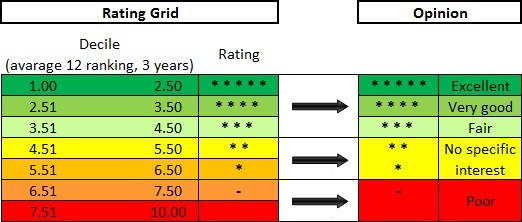
This collection of important methodological principals has been retained and applied in order to establish our system of rating. This system of rating permits the identification of funds which on average over 3 years, have better performed that their rivals and allows the investor to choose the best product over the medium term.
These rules and the pertaining calculations have been validated by the Institute of Dauphine finance over two audits requested by the newspaper Le Monde in 1998 and 2006.